exhibit 02 · April 2026
Stefanie Miriklis
Styx
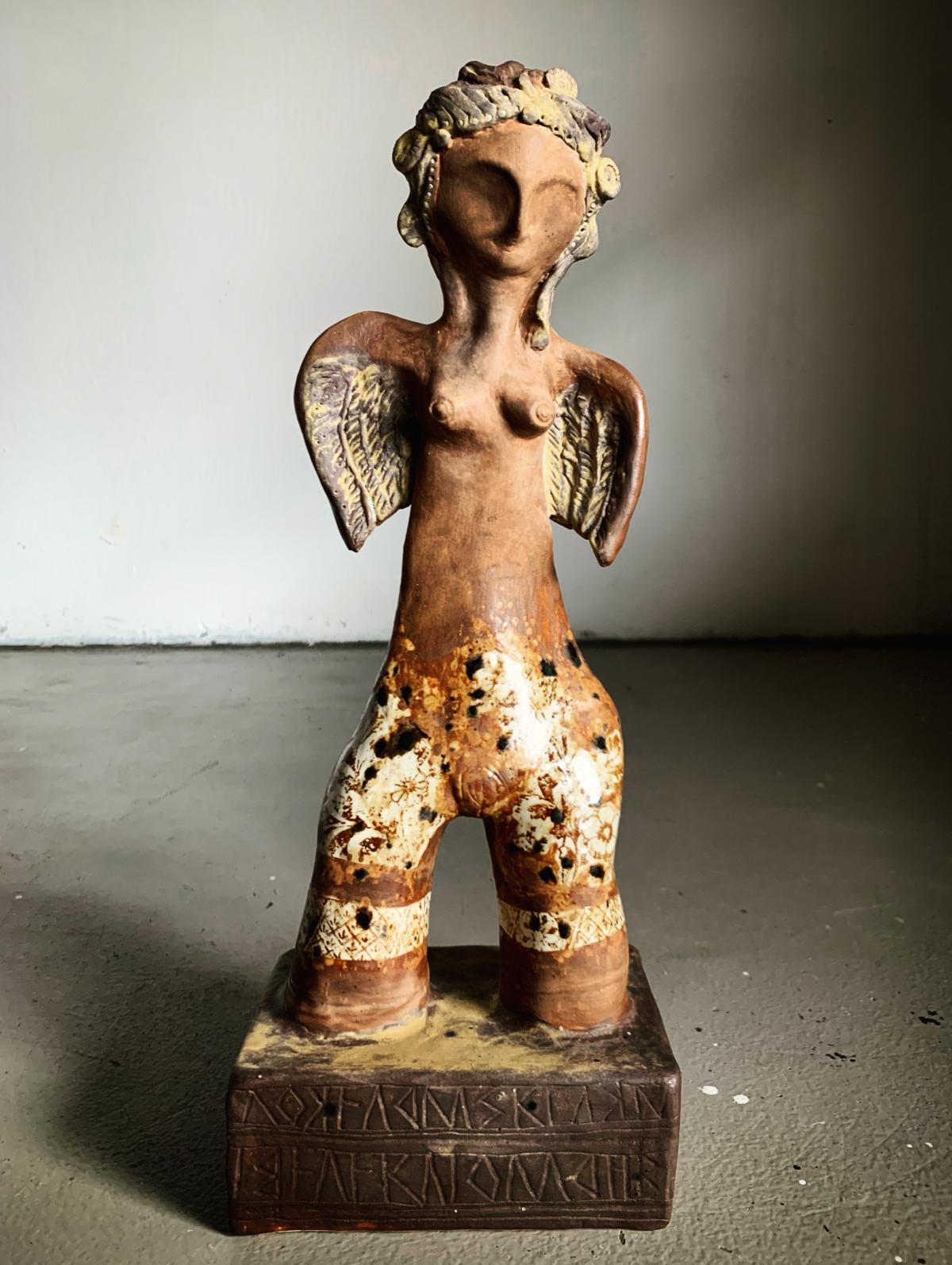
I am a third generation Australian of Greek and Latvian descent who grew up roaming the green hills of Bundjalung country. My practice spans hand-formed ceramics, found object assemblage, and mosaic. This piece was created during my 2025 residency at the Converge artists studio in Lismore. An incubator program funded by the NSW Reconstruction Authority to support the community arts sector in the wake of the 2022 Floods. Imbued with memory and a quiet sense of guardianship, this work is a luminous story-carrier. Layered glazes and ornate details give rise to symbolic beings—echoes of ancient worlds and sacred testimony to the personal realities of climate change. Born from the experience of the 2022 Lismore floods, this work reflects on how catastrophe alters us and how the objects we keep close can be both anchors and breakable.
audio guide · 18 min
artist’s chosen music
'The Way It Will Be' by Gillian Welchinterview transcript
Welcome to the monoseum. My name is Stephanie Miriklis. I am the daughter of a Greek man and a Latvian woman. I suppose you could describe me as a creative entity that's sometimes sighted traipsing around the Northern Rivers region. I'm someone who loves art, food, interiors, nature, community, local history and science. Originally, I was born in Victoria, and my mother moved to the Northern Rivers region with my brother and I when we were quite young. I grew up in a dairy bale on a beautiful old farm property in Modanville. It was quite an idyllic childhood — wandering around barefoot through lush green paddocks, climbing big fig trees, exploring creeks, maybe going up to the Dunoon store on a hot summer's day for lemonade icy poles. It was a very simple, semi off-grid way of life, back in the early hippie days of the Northern Rivers region. It was quite a magical time to grow up in that area, before it was developed into what we see now. I attended Lismore High School and went to Southern Cross University, then spent a little bit of time in the big smoke. I moved to Sydney and spent ten years in the city, which was a lot of fun, but I really missed the Northern Rivers region and eventually came back to live and work. For a period I was living in a really beautiful old 1940s farm shack over in Modanville — a delightful and enchanting old house, and again a beautiful way to connect with nature, living off-grid on a big old farm property. I think I'm definitely more of a regional, hills girl than a coastal person. I was someone who went through the 2022 floods, as many people from this region were. It was a very crazy experience to be stripped of all of my worldly possessions in one big flush of muddy water — something I will never forget. Swimming out of my house with the clothes on my back and my poor little pussy cat in a laundry tub, we paddled down the street to safety. It was quite a devastating time to lose so much — my art studio, my journals, my collection of books, everything I had collected over so many years. It was a very dark time for the entire community, and I was quite lost after that experience. I panicked and just wanted to get back to working and get my life back together, so I dedicated a period of time to doing that. I was fortunate enough to be chosen as one of the artists in residence at the Converge Incubator Program, held in Lismore, funded by the New South Wales Reconstruction Authority and facilitated by Lismore City Council. It was amazing to be given a year to get back on track in my art practice — to have studio space, creative development programs, and to really allow myself the time to dedicate to creating again. It was just the most incredible experience, and I'm very thankful for it. During that time I created a large body of work which was exhibited at the end of the program. My practice really began when I was a young child. I was one of those kids that just loved doing anything creative. I used to make little dolls and teddy bears, and I would find things in nature to make little objects. I remember one day we were hanging out with some of my mum's friends out at Nimbin, and they had just redone the road, and there was all this raw clay on the edge of the nature strip out the front of the property. I just sat outside in the garden making these little clay pots. It was something that always came quite naturally to me — to explore and create. Growing up in the Northern Rivers region before mobile phones was a pretty special time. I had an amazing friend during primary school — just the most incredible young woman, who has grown up to be a very intelligent, lovely lady working in the arts down in Canberra. Her father was an artist, and we spent a lot of time on her property. We believed in fairies. We'd create maps of the worlds our fairies lived in and spend our days talking to our imaginary fairy friends, protecting the house from goblins by making these strange little sculptures that would hang off door handles around the house. Her mum was a nurse and I think she thought we were quite mad, but her dad was an amazing artist and I think he really enjoyed watching us grow up in such a creative way. I later went on to study printmaking at Southern Cross University, which I really enjoyed. I'm an extremely tactile person and I really love the process of printmaking, and I love paper. It was something I really enjoyed as a young artist. Later in life I went on to work in a stationery store in Double Bay, creating invitations for Sydney's finest, which was lots of fun too. I've had a very diverse life with lots of interesting points throughout. My practice today is really ceramics and mosaic. I work at Northern Rivers Tiles, and a couple of years ago, before the flood, my boss offered me a spot in a mosaic workshop. I went along, and my head just kind of popped — I realised you could really approach mosaic like painting. It was a medium that had always been at my fingertips, working in the tile industry, but I had just never thought about it. From that moment I became obsessed with mosaic-making, looking at traditional styles but also the French pique assiette — the broken pieces and shards. Through the Converge program I mashed everything together and created a body of work incorporating mosaic elements alongside two and three dimensional ceramic forms. I created a series of figurative works representing Pyrrha, drawing on Greek mythology and stories of floods, survival, and how people put the pieces of their lives back together after a catastrophic event. Pyrrha was the daughter of Zeus. In Greek mythology, the gods — furious with humankind after Pandora opened her box, bringing greed, anger, jealousy and hate into the world for the first time — sent a giant flood down to earth. Pyrrha and her partner Deucalion were warned and prepared a boat, sailing across the flooded lands. When the rain subsided, they found themselves alone — everyone else was gone. Eventually they came to the Temple of Themis, where they saw an Oracle. They begged for help, pleading to have the human race restored. The Oracle told them: take the bones of your mother and throw them over your left shoulder. At first they were confused, but they came to understand that the bones of mother were Mother Earth. They began their journey, picking up rocks from the ground and throwing them behind their left shoulder without looking back. Where those rocks landed, a new form of humankind grew — restoring a more kind and considerate mindset to the people of the earth. It was a really beautiful story that resonated with me, reflecting on my heritage but also looking at a bigger picture. You've got the personal stories, and you've got the climate catastrophe happening in the world — and this story captures the way communities come together and rebuild. Through the medium of mosaic, which in its physicality is literally about breaking and piecing things back together, incorporating broken elements and reconfiguring them into something new, I thought those figurative works were a beautiful translation of that process — a nod to a bigger story. The piece in the monoseum is a stoneware ceramic work called Styx. In Greek mythology, Styx was a goddess, but also a river in the underworld. Reflecting on my experience of the flood and drawing on that, I didn't want to create works that were too literal about what the community went through. I wanted to reflect further on my own place in the world and my cultural identity — looking at Greek mythology and Latvian mythology and symbolism, and creating a three-dimensional goddess-type character. She turned out really beautifully. During the residency I did an intensive workshop at Northern Rivers Pottery Supplies with Raven on surface decoration, and I learned how to screen print glaze and use it as a paper transfer. I had taken images from ceramic crockery I owned that had gone through the flood, scanned them, and turned them into glaze transfer prints on her body. She's quite a beautiful character — something ancient and protective. I think she has quite a benevolent gaze. One piece of advice I would give to someone beginning their art practice: be brave. I was very shy when I was younger, and looking back with the power of hindsight, I wish I'd had a little more confidence in myself as a young artist. You've just got to get out there and do the work. A lot of people have amazing skills in all different fields — whether you're an amazing gardener, a cook, a musician, a healer. There are all sorts of people who do incredible things. We're our own worst critics, and perhaps we think what we're doing isn't quite special enough. But other people look at what artists do and wonder how you come up with your ideas, or how you just know to do something. My brother's a computer programmer, and I remember having a conversation with him about creativity. I said there's no way I could write code like that — it just doesn't make sense to me. And he said: Steph, how do you know how to just make something? How do you start the process? That confidence in yourself will come. Just make the work, and don't be too hard on yourself about it — because the good stuff really comes when you've gone through it a little, and you start seeing things emerge that you never predicted. That's part of the process. The good stuff comes from just doing the work, and you see the progression of ideas and the development of concepts. But it's not going to happen if you don't stick to it. The song that I have chosen to accompany this artwork is a beautiful song by Gillian Welch and it's called 'The Way It Will Be'. So I first heard this song when it was played on the radio and it was during Cyclone Alfred when all of the Northern Rivers region was told to remain indoors and basically batten down the hatches. It was my birthday around that time and my housemates and I were all cooped up and going a little bit stir-crazy with cabin fever and slightly freaking out with the impending threat of another catastrophic flood on its way to Lismore. So we were listening to River FM which really is the go-to radio station for this region whenever an event like that is taking place because they give regular creek and river height totals throughout the duration of the weather event and they also take song requests to kind of fill in the time. So we were ringing up and requesting all sorts of crazy cyclone and water theme songs things like 'Spinning Around' by Kylie Minogue and we were having a merry old time dancing around my lounge room listening to the radio and my brother requested this song for me and he lives further up north but it was just a really kind of interesting night and it felt very innocent in a sense. It kind of felt like we were kids again and just that thrill of calling up the radio and hearing your song being played it was just a really beautiful special kind of sweet sweet time to take us through the terror of Lismore going under again and thankfully it didn't happen but yeah this song pops up on my playlist and I hope you enjoy it.
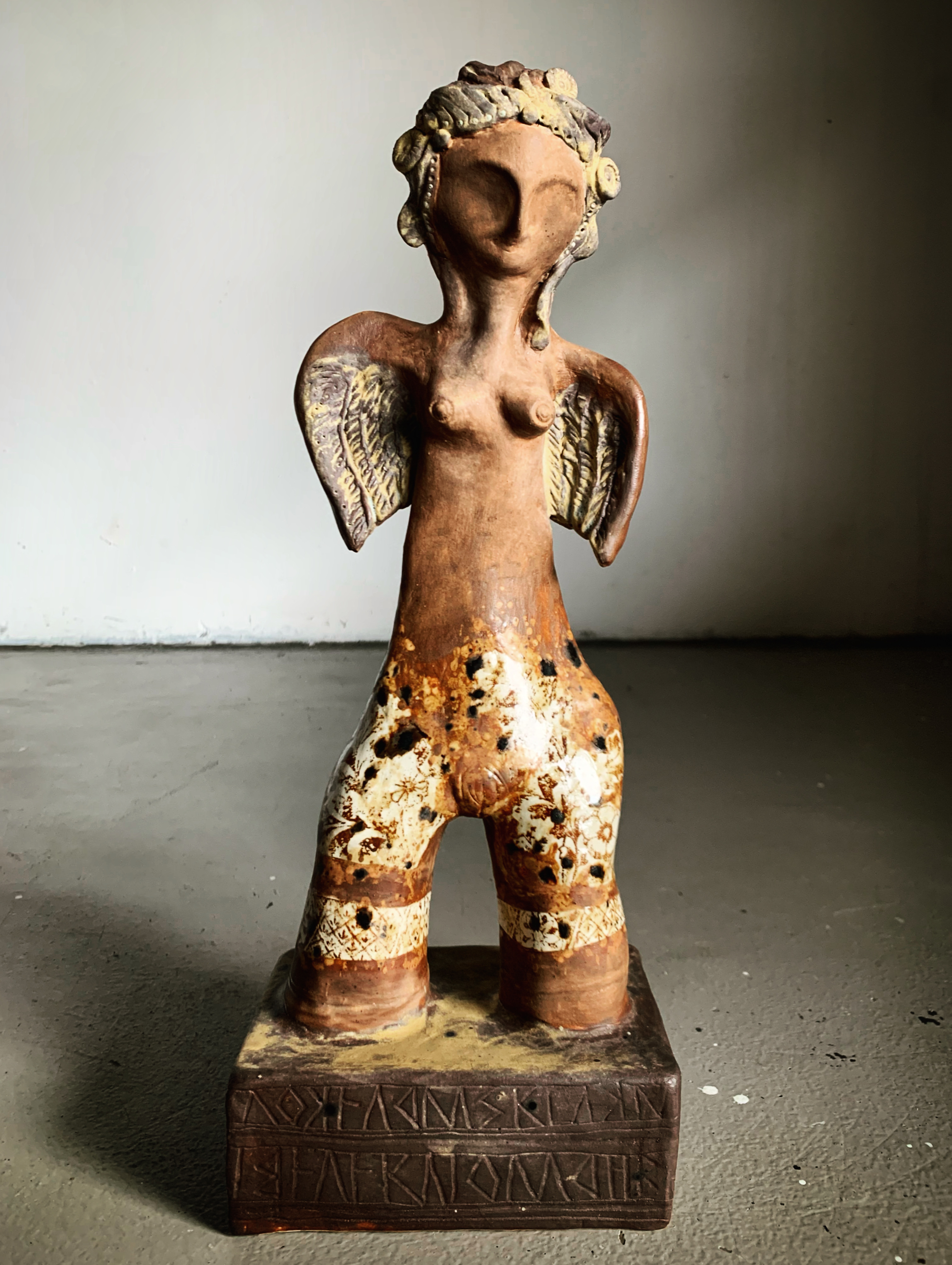
Winged Venus of Bundjalung?, took my mind to Makapansgat pebble and in turn to the Venus of Dolní Věstonice (Věstonická venuše), thirty thousand years old and apparently bears a fingerprint of a child prior to firing. In 2025, the 100th anniversary of its discovery has been commemorated i.e. by the decision to place a silhouette of the figurine on a scientific instrument built by a consortium of companies from Brno for the European Space Agency (ESA) space probe EnVision that will explore the planet Venus. I love your Venus so much better; it's indigenous connection with the oldest living culture and the fact that it has a pair of serviceable wings I reckon she should keep Věstonické venuši company on the flight to Venus. Spent Half hour to decipher the letters, but no joy. Congrats on very beautiful piece of intriguing sculpture.
Winged Venus of Bundjalung?, took my mind to Makapansgat pebble and in turn to the Venus of Dolní Věstonice (Věstonická venuše), thirty thousand years old and apparently bears a fingerprint of a child prior to firing. In 2025, the 100th anniversary of its discovery has been commemorated i.e. by the decision to place a silhouette of the figurine on a scientific instrument built by a consortium of companies from Brno for the European Space Agency (ESA) space probe EnVision that will explore the planet Venus. I love your Venus so much better; it's indigenous connection with the oldest living culture and the fact that it has a pair of serviceable wings I reckon she should keep Věstonické venuši company on the flight to Venus. Spent Half hour to decipher the letters, but no joy. Congrats on very beautiful piece of intriguing sculpture.
leave a comment