exhibit 01 · March 2026
Katka Adams
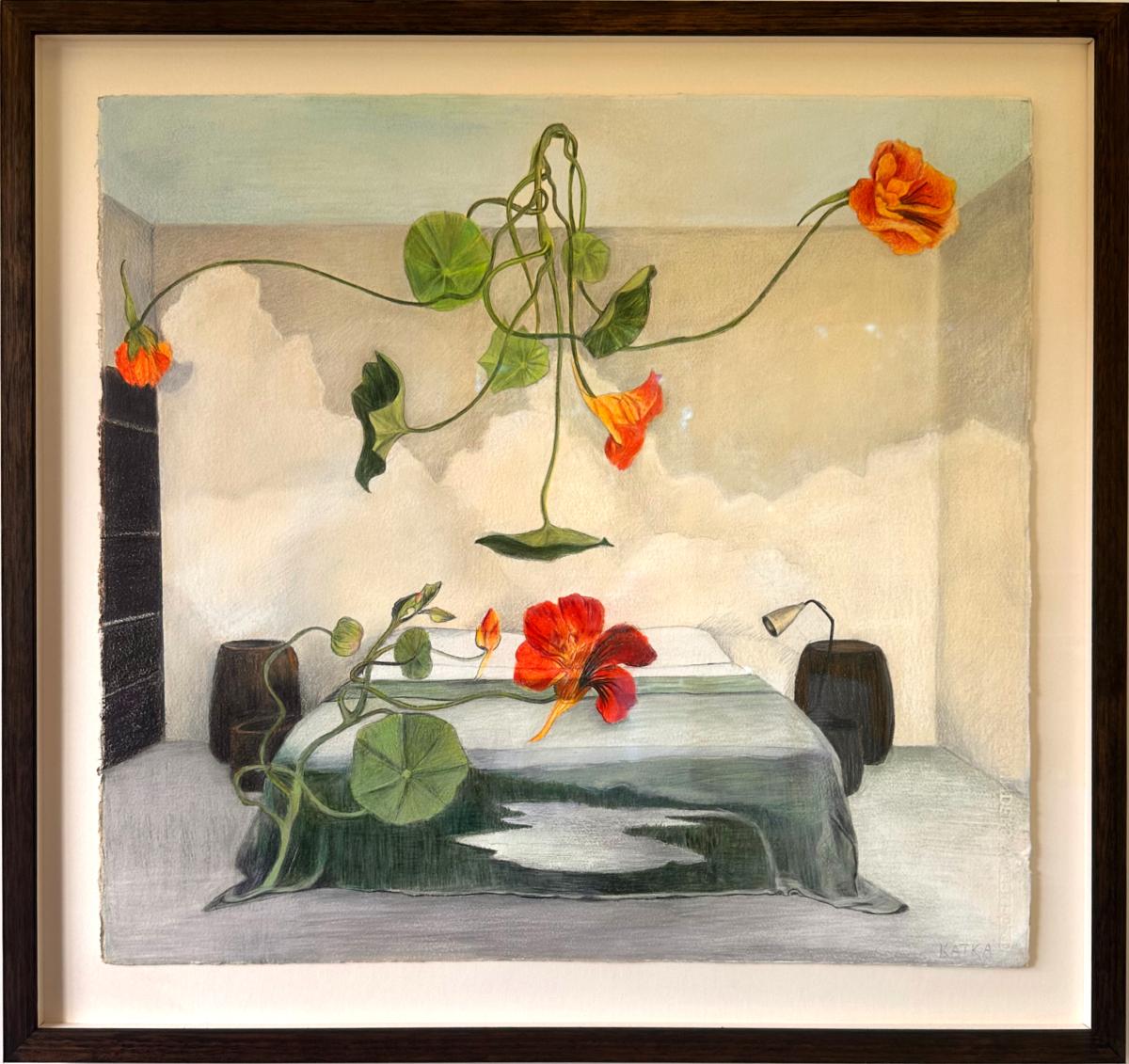
Nasturtium Room
This work emerged following the death of my father-in-law after weeks of visiting him in palliative care. The empty room came first, with the empty bed. As I coloured the bedspread, the lines reminded me of hills, and slowly a landscape appeared with a lake and a waterfall. I was thinking about the emptiness left behind when a loved one is gone, and I wanted to fill it with life. The nasturtiums were growing in my garden at the time, and I added them to represent vibrant energy and new growth.
audio guide · 9 min
artist’s chosen music
"Black Catbird" The Garifuna Collectiveinterview transcript
Welcome to the monoseum. I’m Katka Adams. I was born in Prague in the 1960s. When Russia invaded in 1968, my mother and I left the country. We lived in Vienna for a while, and then Australia brought us out as political refugees.
I went from being six years old in a Czech-speaking family—already able to read and write—to suddenly being in another country, in a migrant camp. My mother had to work in factories, and I became quite withdrawn. No one could understand me speaking, and I couldn’t read or write in English, even though I could do all of that in a different language. It was very stressful.
Drawing became a way for me to express myself and to communicate. It helped people understand me without language, and I received a lot of affirmation through my art. There were many adults in my life and no other children. My mother was very young, and we were surrounded mostly by late teenagers and people in their early twenties. They responded strongly to my drawings. They would hold them up and admire them. My art became my tool for communicating and also for being liked, valued, and admired. It became something I valued deeply, and something people valued me for.
That continued through primary school and into high school. In Year 10 we had to complete career questionnaires about what we were going to do with our lives. Mine came out “Artist.” I thought, of course—I’m an artist. But my teacher said I needed a backup plan because I wouldn’t make money as an artist. Still, I always knew that was my path.
I went to Sydney College of the Arts and studied visual art, focusing on painting, and completed a degree. We were living in Sydney then. I met my partner, and we moved to Lismore when he got a job at Lismore Base Hospital. We started a family. When the children went to school, I went to TAFE for further study.
That was important, because at art school the approach was very progressive and conceptual. I learned how to think about my art—how to bring meaning into it, how to tell stories, how to give it content. But I didn’t learn many practical drawing or painting skills. At Lismore TAFE, I focused on basic drawing and painting skills. I was then able to marry the two together.
My art is narrative. It tells stories. The piece I’m showing in the phone booth comes from an experience I had last year. All of my work comes from personal experiences and from the life I’m living—how I’m impacted by what happens around me, in my environment and in my community.
My father-in-law was diagnosed with cancer and given six weeks to live. He was 94 and in hospital. We visited him regularly. I realise now that he is the only person I have been able to say goodbye to while they were dying. Everyone else in my life died suddenly, and I found out afterwards. This time was different. I would sit with him, hold his hand, and visit a couple of times a week. It changed our relationship completely. He became very loving and accepting, and we were simply able to be together. It was a special time.
After he died, the room was empty. The bed was empty. That’s where the drawing comes from. At first, when I drew it, the life was gone and the image felt very quiet. I didn’t want that. I wanted there to be life in the space. So I added nasturtiums from my garden. I would bring them in and look at them. In the drawing they became very large, filling the room. I wanted to fill that empty space with life again.
As I was colouring the bedspread, I noticed the folds looked like mountains. The colour reminded me of a forest. That’s how I work—my mind jumps. I thought, let’s make it a forest. Let’s make it a landscape. The water became a lake that poured down onto the ground. I added water across the floor. It turned into a landscape inside a room, speaking about death but also about life. A person dies, but life continues.
The work fits my way of working. Something happens. I think about it. I start drawing. Then the drawing leads me. New ideas appear, and it keeps changing and flowing. The advice I would give someone starting an art practice is to enjoy the process and not focus on the end result. Don’t draw for someone else. Don’t try to please other people or think about producing a product. Think of it as a practice. Start colouring. Choose colours you like. Choose a topic you like.
If you’re just beginning, get a small book and draw something simple—your teacup in the morning, a dandelion you pick. Choose something you can look at, but don’t expect to replicate it exactly. Let the drawing evolve into something you like. The main thing is to enjoy yourself. Do it for yourself.
The theme of nature is very important to my work, so I chose this song called the Black Catbird by the Garifuna collective. It's from an album titled A Guide to the Bird Song of Mexico, Central America and the Caribbean. My studio, the drawing room, is behind Clunes Park, and I listen to birds all day as I work. I feel like this song reflects that mood and creates a beautiful, gentle backdrop to experiencing this artwork.
no comments yet — be the first.
leave a comment